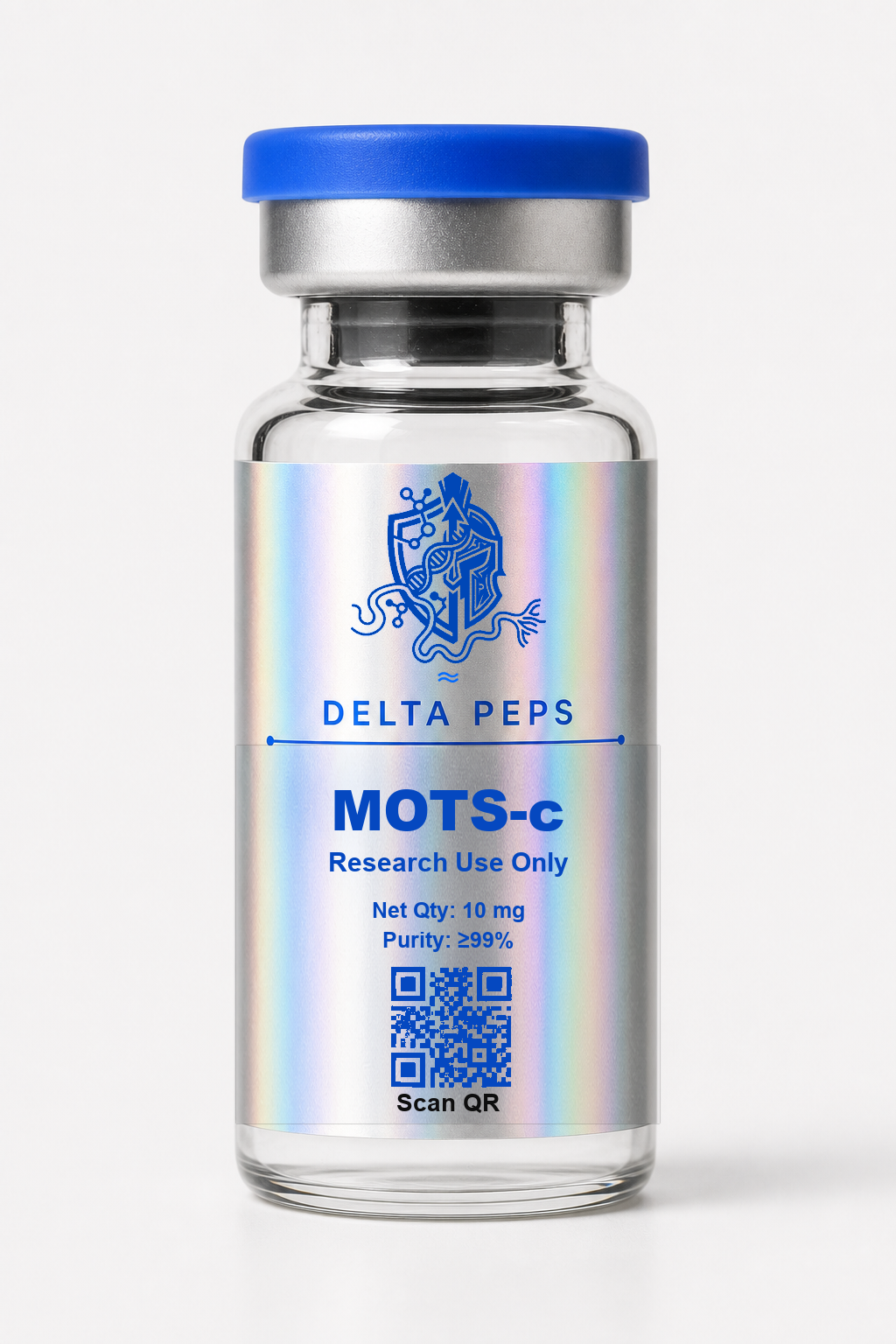
MOTS-c Peptide — For Research Use Only
Research Use Only. All products currently listed on this site are for research purposes only. Products are not intended for human or animal consumption, dosing, injection, ingestion, or therapeutic use.
Inventory waitlist open — documentation available now
FOR RESEARCH USE ONLY. Not for human consumption, medical use, or therapeutic application of any kind.
Batch specifications
- Compound
- MOTS-c Peptide
- Net quantity
- 10 mg
- Form
- Lyophilized powder
- HPLC purity
- ≥99%
- Current lot
DP-MOTSC-001- Testing panel
- HPLC · Mass Spec · LAL Endotoxin
- Storage
- -20°C long-term; 2–8°C active use
Lot Documentation & Testing
Each lot is tested by HPLC (purity), mass spectrometry (identity confirmation), and LAL endotoxin assay prior to release. COA documentation is pending finalization — lot number is reserved and testing is underway. QR-linked COA will be published to the vial and the COA library when the batch is released.
Join the inventory waitlist. This batch is not yet available to order. Review the COA and specifications above, then request notification when inventory opens.
Request inventory alert
FOR RESEARCH USE ONLY — Molecular Research Profile
MOTS-c — Molecular Research Profile
MOTS-c (Mitochondrial Open Reading Frame of the 12S rRNA type-c) is a 16-residue mitochondrial-derived peptide (MDP) encoded within an alternative open reading frame of the 12S rRNA region of human mitochondrial DNA, with the sequence MRWQEMGYIFYPRKLR — an amphipathic, net cationic (+4 charge at pH 7.4) peptide whose cationic C-terminal region confers cell membrane-translocating properties measurable in fluorescent-probe uptake assays, and whose intracellular activity is characterized by AMPK pathway activation in cell-based phosphorylation assays.
Molecular Architecture
- Sequence
- Met-Arg-Trp-Gln-Glu-Met-Gly-Tyr-Ile-Phe-Tyr-Pro-Arg-Lys-Leu-Arg (MRWQEMGYIFYPRKLR); 16 residues
- Molecular weight
- 2,174.6 Da (free base); confirmed by MALDI-ToF and ESI-MS; [M+H]⁺ = 2175.6
- Net charge
- +4 at pH 7.4 (Arg², Arg¹³, Lys¹⁴, Arg¹⁶); basic pI ~11.2; cationic C-terminus drives membrane association in cell-uptake assays
- Secondary structure
- C-terminal segment (Pro¹²-Arg-Lys-Leu-Arg) adopts extended or polyproline-type conformation; N-terminal hydrophobic core (Trp-Gln-Glu-Met-Gly-Tyr-Ile-Phe-Tyr) creates amphipathic character; no tertiary structure in solution
- Genetic origin
- Encoded by ORF within 12S mt-rRNA (human mt-genome position ~956-1005); translated by mitochondrial ribosomes; exported to cytoplasm via mechanism under active investigation
- Modifications
- No disulfide bonds; no lipidation; no glycosylation in synthetic form; unmodified free acid; N-terminal Met intact
Intracellular Target and Signaling Mechanics
MOTS-c does not engage a classical cell-surface GPCR. Its primary characterized intracellular interaction is AMPK (AMP-activated protein kinase) activation: treatment of HEK293 cells or L6 myoblasts with MOTS-c at 1–10 µM elicits AMPKα1 Thr172 phosphorylation measurable by Western blot and HTRF (Lee et al., 2015 Cell Metab. 21, 491-505). Cellular uptake is concentration-dependent and partially inhibited by dynasore (endocytosis inhibitor) in confocal assays using FITC-MOTS-c conjugate. Under oxidative-stress conditions in H₂O₂-treated HEK293 cells, FITC-MOTS-c translocates to the nucleus, where it modulates ARE-driven reporter activity.
Intracellular signaling cascade:
- Cellular uptake: MOTS-c → endocytosis-mediated or direct membrane translocation → cytoplasmic localization (FITC-MOTS-c confocal assay)
- AMPK activation: AMPKα1 Thr172 phosphorylation (Western blot or HTRF; 1–10 µM in HEK293 or L6; 1 h at 37°C)
- AMPK → ACC Ser79 phosphorylation → malonyl-CoA suppression (metabolic flux readout by ¹⁴C-acetate labeling assay)
- AMPK → PGC-1α co-activator assay: CRE-luciferase or PGC-1α promoter reporter in transfected myoblasts
- Nuclear translocation (oxidative stress context): FITC-MOTS-c → nucleus → ARE-luciferase reporter activation in Nrf2-ARE stable HEK293 cells
- MOTS-c does NOT activate GLP-1R, GLP-2R, GHRHR, or GCGR in standard HTRF cAMP assays
In Vitro Research Profile
- Primary assay
- AMPKα Thr172 phosphorylation by Western blot or HTRF in HEK293 or L6 myoblasts; 1 h incubation at 37°C; EC50 ~1–3 µM per Lee et al. 2015; AICAR (positive control) at 1 mM
- Uptake assay
- FITC-MOTS-c (fluorescent conjugate) uptake by flow cytometry or confocal microscopy; concentration range 0.5–25 µM; 30-min incubation; dynasore (80 µM) as endocytosis inhibitor control
- Metabolic assay
- Seahorse XF Analyzer: oxygen consumption rate (OCR) and extracellular acidification rate (ECAR) in MOTS-c-treated vs. vehicle-treated L6 myoblast cultures; 1–10 µM; 24 h pre-treatment
- Nuclear pathway assay
- Nrf2-ARE luciferase reporter in stable HEK293 cells; H₂O₂ (100 µM) co-treatment to model oxidative stress context; 6 h readout; compare vs. sulforaphane positive control
- Concentration range
- 0.5–50 µM; Lee et al. (2015) reports meaningful AMPKα phosphorylation from ~1 µM; concentrations > 25 µM should include viability assessment (MTT or CellTiter-Glo)
- Stability notes
- Stable at -20°C in PBS pH 7.4; monitor integrity by RP-HPLC after freeze-thaw cycles; basic peptide (pI ~11.2) may adsorb to polypropylene at low concentrations — use LoBind or silanized tubes below 1 µM
Research Use Only — Regulatory Notice
All compounds on this page are sold exclusively for in vitro laboratory research. They are not approved by the FDA, DEA, or any regulatory agency for human or animal use, therapeutic application, clinical investigation, or consumption of any kind. Binding affinities, IC50/EC50 values, and signaling cascade descriptions referenced herein derive from published in vitro and cell-based literature and do not constitute efficacy or safety claims. Researchers are responsible for complying with all applicable institutional, local, and federal regulations governing the handling and use of research chemicals.