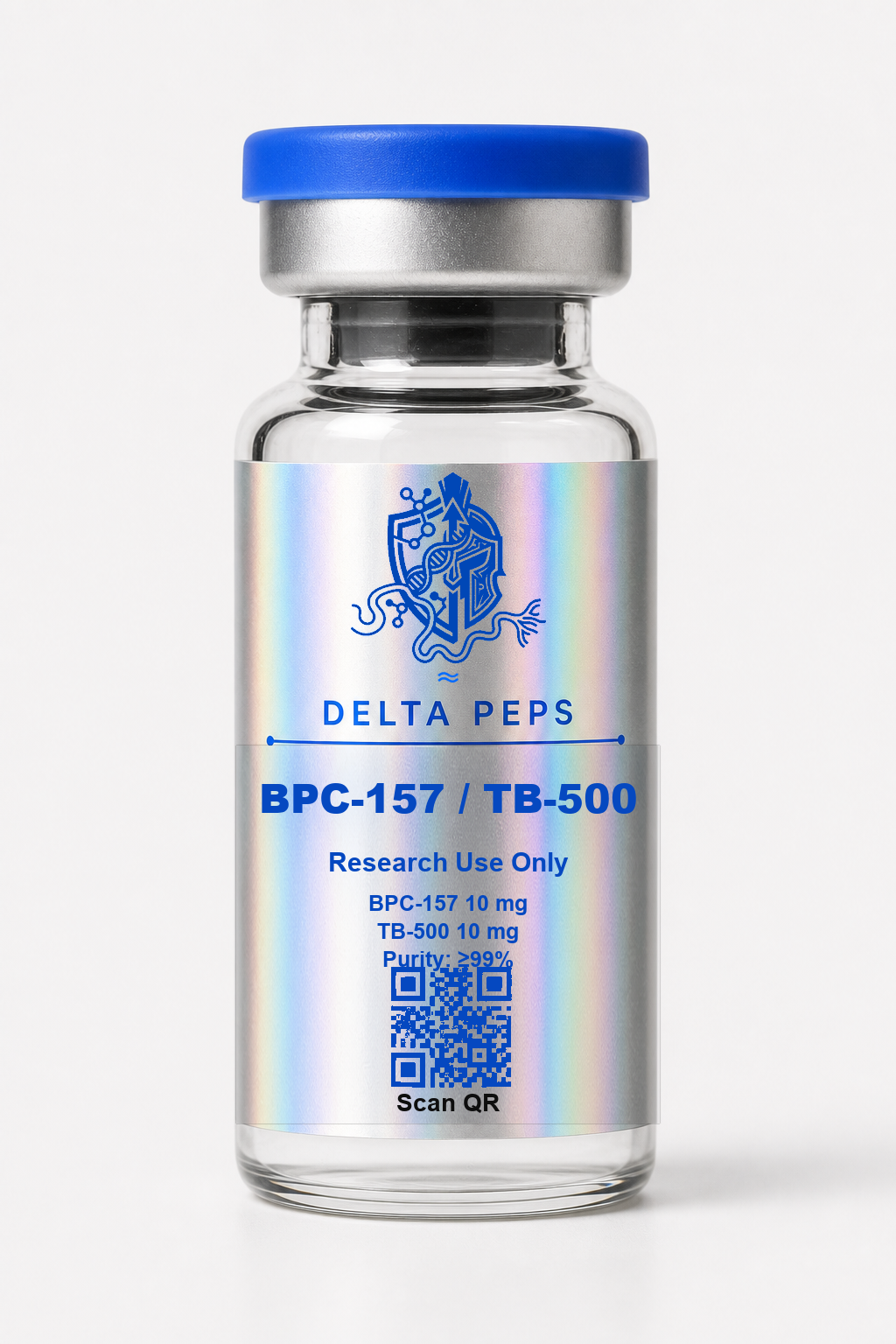
BPC-157 / TB-500 Research Blend — For Research Use Only
Research Use Only. All products currently listed on this site are for research purposes only. Products are not intended for human or animal consumption, dosing, injection, ingestion, or therapeutic use.
Inventory waitlist open — documentation available now
FOR RESEARCH USE ONLY. Not for human consumption, medical use, or therapeutic application of any kind.
Batch specifications
- Compound
- BPC-157 / TB-500 Research Blend
- Net quantity
- 10 mg / 10 mg
- Form
- Lyophilized powder
- HPLC purity
- ≥99% (each component)
- Current lot
DP-BPC-001- Testing panel
- HPLC · Mass Spec · LAL Endotoxin
- Storage
- 2–8°C, protected from light
Lot Documentation & Testing
Each lot is tested by HPLC (purity), mass spectrometry (identity confirmation), and LAL endotoxin assay prior to release. COA documentation is pending finalization — lot number is reserved and testing is underway. QR-linked COA will be published to the vial and the COA library when the batch is released.
Join the inventory waitlist. This batch is not yet available to order. Review the COA and specifications above, then request notification when inventory opens.
Request inventory alert
FOR RESEARCH USE ONLY — Molecular Research Profile
BPC-157/TB-500 Research Blend — Molecular Research Profile
BPC-157/TB-500 Research Blend is a two-component lyophilized preparation combining BPC-157 (pentadecapeptide Gly-Glu-Pro-Pro-Pro-Gly-Lys-Pro-Ala-Asp-Asp-Ala-Gly-Leu-Val; MW 1,419.5 Da) and TB-500 (a synthetic fragment corresponding to the Thymosin β-4 actin-binding domain; ~2,100–2,200 Da) — two structurally unrelated peptides with mechanistically distinct in vitro profiles, one characterized by interactions at FAK/VEGFR kinase-signaling nodes and the other by G-actin sequestration kinetics and ILK-pathway activation.
Molecular Architecture — Per Component
- BPC-157 sequence
- Gly-Glu-Pro-Pro-Pro-Gly-Lys-Pro-Ala-Asp-Asp-Ala-Gly-Leu-Val (15 residues, single-letter: GEPPPGKPADDAGLV)
- BPC-157 MW
- 1,419.5 Da (free acid); ESI-MS confirms [M+H]⁺ = 1420.5; triple Pro-Pro-Pro motif creates rigid polyproline II helix segment; no disulfide bonds; no PTMs in synthetic form
- TB-500 sequence
- Synthetic fragment of Thymosin β-4 corresponding to the LKKTETQ-flanked actin-binding SDKPDMAEIEKTDKSKLKK region; commonly cited as 17 residues with N-terminal acetylation
- TB-500 MW
- ~2,100–2,200 Da depending on precise sequence boundaries; confirmed by MALDI or ESI-MS; no disulfide bonds; linear peptide with N-terminal Ac group
- Blend composition
- 10 mg BPC-157 + 10 mg TB-500 per vial; co-lyophilized; each component ≥99% HPLC purity (individual chromatograms available in lot documentation)
Receptor Binding and Signaling Mechanics
BPC-157 does not engage a confirmed classical GPCR or kinase receptor with published Kd or Ki data as of 2025; published cell-based evidence characterizes BPC-157 through FAK Tyr397 phosphorylation assays and VEGFR2 (KDR) proximity studies in HUVEC and NIH3T3 cell lines (Gwyer et al. 2019 review). TB-500 acts through G-actin sequestration (Kd ~0.1–0.5 µM in pyrene-actin and latrunculin competition assays), without GPCR involvement, with downstream ILK activation leading to PI3K → Akt Ser473 phosphorylation in cell-based Western blot assays (Hannappel & Huff, 2003 Vitam. Horm.).
Intracellular signaling cascade:
- BPC-157: FAK Tyr397 autophosphorylation in HUVEC/NIH3T3 (proposed interaction at FAK-paxillin complex; Western blot)
- BPC-157: ERK1/2 Thr202/Tyr204 phosphorylation in HUVEC cell assays at 10⁻¹⁰–10⁻⁷ M (Western blot, HTRF)
- BPC-157: NF-κB p65 nuclear translocation assay (reporter assay in macrophage cell lines)
- BPC-157: eNOS Ser1177 phosphorylation in HUVEC assays; NO production measurable by DAF-FM fluorescent probe
- TB-500: G-actin binding → actin polymerization inhibition → ILK activation → PI3K → Akt Ser473 (Western blot or HTRF in HUVEC)
- Blend convergence point: Both components can independently modulate ERK1/2; individual-component controls essential for attribution
In Vitro Research Profile
- BPC-157 primary assay
- FAK Tyr397 and ERK1/2 phosphorylation by Western blot or HTRF; HUVEC or NIH3T3 cell lines; concentration range 10⁻¹⁰–10⁻⁷ M; 15-min treatment at 37°C
- BPC-157 secondary assay
- eNOS Ser1177 phosphorylation by HTRF in HUVEC; NO production by DAF-FM (4-amino-5-methylamino-2′,7′-difluorofluorescein) fluorescent probe at 495/515 nm
- TB-500 primary assay
- G-actin sequestration: pyrene-actin polymerization kinetics (ex. 365 nm / em. 407 nm); co-sedimentation at 100,000 × g; Kd determination by dose-response curve
- TB-500 secondary assay
- ILK activity assay → Akt Ser473 Western blot in HUVEC cells; 0.1–10 µM TB-500; 60-min treatment; compare vs. ILK inhibitor (cpd22) control
- Blend design note
- Run each component individually alongside blend wells in every experiment; phosphoprotein multiplex (Bio-Plex or Luminex) recommended for simultaneous ERK/Akt/FAK/eNOS profiling
- Known limitations
- BPC-157 primary receptor has not been confirmed; no published Kd or Ki for a defined molecular target; mechanistic literature remains largely correlational
Research Use Only — Regulatory Notice
All compounds on this page are sold exclusively for in vitro laboratory research. They are not approved by the FDA, DEA, or any regulatory agency for human or animal use, therapeutic application, clinical investigation, or consumption of any kind. Binding affinities, IC50/EC50 values, and signaling cascade descriptions referenced herein derive from published in vitro and cell-based literature and do not constitute efficacy or safety claims. Researchers are responsible for complying with all applicable institutional, local, and federal regulations governing the handling and use of research chemicals.