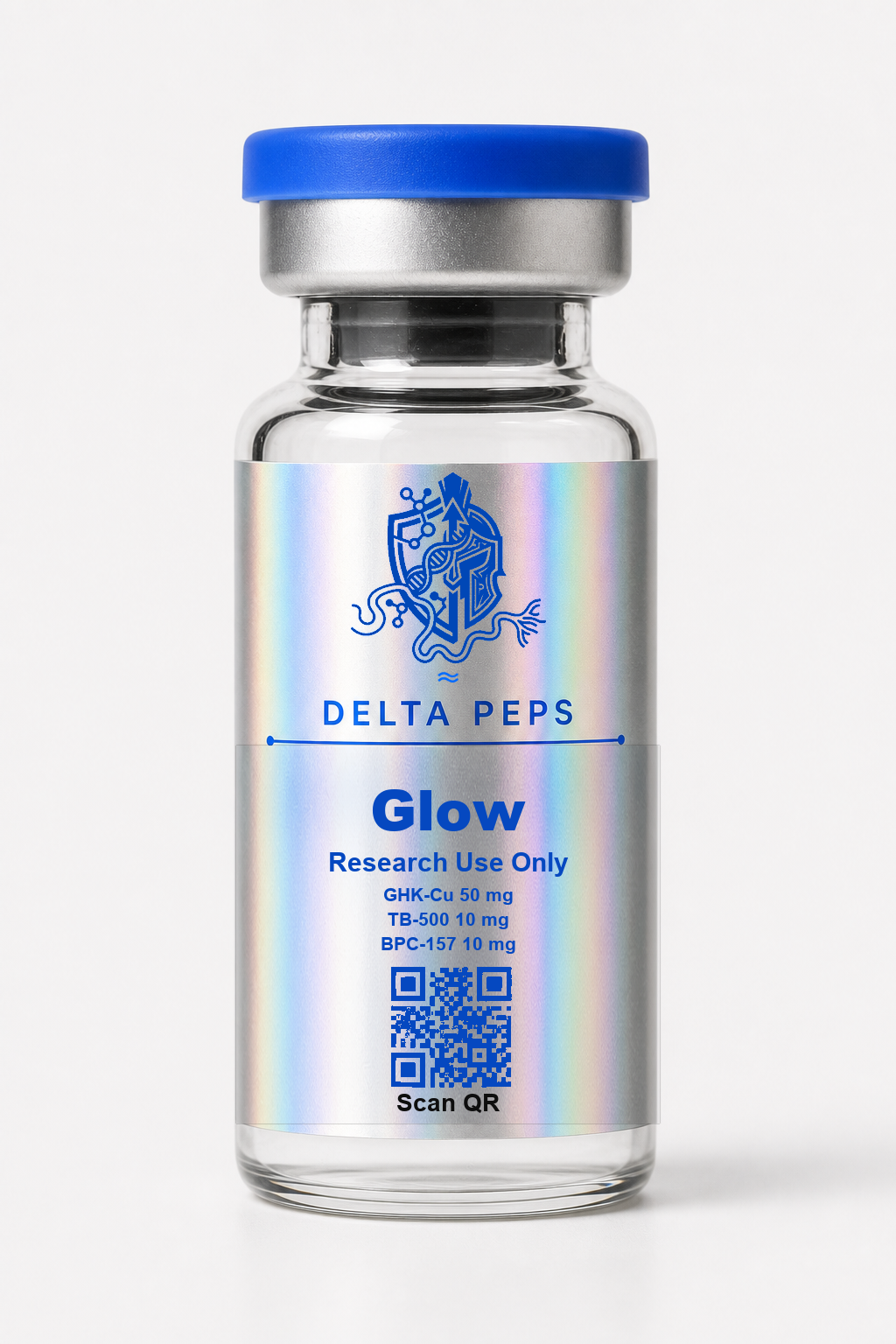
Glow — GHK-Cu / TB-500 / BPC-157 Research Blend
Research Use Only. All products currently listed on this site are for research purposes only. Products are not intended for human or animal consumption, dosing, injection, ingestion, or therapeutic use.
Inventory waitlist open — documentation available now
FOR RESEARCH USE ONLY. Not for human consumption, medical use, or therapeutic application of any kind.
Batch specifications
- Compound
- Glow — GHK-Cu / TB-500 / BPC-157
- Net quantity
- Multi-component blend
- Form
- Lyophilized powder
- HPLC purity
- ≥99% per component
- Current lot
DP-GLOW-001- Testing panel
- HPLC · Mass Spec · LAL Endotoxin
- Storage
- 2–8°C, protected from light
Lot Documentation & Testing
Each lot is tested by HPLC (purity), mass spectrometry (identity confirmation), and LAL endotoxin assay prior to release. COA documentation is pending finalization — lot number is reserved and testing is underway. QR-linked COA will be published to the vial and the COA library when the batch is released.
Join the inventory waitlist. This batch is not yet available to order. Review the COA and specifications above, then request notification when inventory opens.
Request inventory alert
FOR RESEARCH USE ONLY — Molecular Research Profile
Glow — Molecular Research Profile
Glow is a three-component lyophilized research blend comprising GHK-Cu (glycyl-L-histidyl-L-lysine copper(II) complex, 340 Da), TB-500 (a synthetic fragment corresponding to the Thymosin β-4 actin-binding domain, ~2,100 Da), and BPC-157 (pentadecapeptide Gly-Glu-Pro-Pro-Pro-Gly-Lys-Pro-Ala-Asp-Asp-Ala-Gly-Leu-Val, 1,419 Da) — three structurally and mechanistically distinct molecules with characterized in vitro interactions spanning copper coordination chemistry, cytoskeletal G-actin sequestration, and cell-signaling kinase-cascade assays.
Molecular Architecture — Three-Component Profile
- GHK-Cu structure
- Gly-His-Lys tripeptide complexed with Cu(II) in square-planar coordination; free peptide MW 340.4 Da, Cu complex 403.9 Da; His imidazole N-δ1 and backbone amide nitrogens are primary Cu coordination sites (Lau & Sarkar, 1981 Biochemistry)
- GHK-Cu copper affinity
- Reported Cu(II) dissociation constant K_Cu ≈ 10⁻¹⁴–10⁻¹⁸ M (physiological Cu competition assay); binds Cu(II) > Zn(II) > Ni(II) in metal competition studies
- TB-500 structure
- Synthetic 17-residue fragment of Thymosin β-4 corresponding to the actin-binding LKKTETQ-flanked motif; MW ~2,100–2,200 Da (MS-confirmed); no disulfide bonds; N-terminal acetylation in native Tβ4 context
- BPC-157 structure
- Gly-Glu-Pro-Pro-Pro-Gly-Lys-Pro-Ala-Asp-Asp-Ala-Gly-Leu-Val; 15 residues; MW 1,419.5 Da (free acid, ESI-MS confirmed); triple Pro-Pro-Pro motif creates polyproline II helix; no disulfide bonds
- Blend formulation
- Co-lyophilized; each component confirmed ≥99% purity by individual HPLC run; researchers should run component-resolved assays using individual standards for mechanistic attribution
Receptor Binding and Signaling Mechanics — Per Component
Each component operates through a mechanistically distinct pathway. GHK-Cu interacts with cell-surface integrins (proposed α2β1 interaction via RGD-like motif; under active investigation) and intracellular SP1 transcription factor binding at GHK-responsive promoter elements in keratinocyte cell-line assays. TB-500 operates through G-actin sequestration (Kd ~0.1–0.5 µM, measured by latrunculin competition assay), activating ILK → PI3K → Akt (Ser473) phosphorylation in HUVEC and NIH3T3 assays with no classical GPCR involvement. BPC-157 has no confirmed primary receptor; published cell-based evidence characterizes interactions with FAK Y397 phosphorylation complexes and VEGFR2 (KDR) in phosphorylation assays (Gwyer et al., 2019 Curr. Pharm. Des.).
Intracellular signaling cascade:
- GHK-Cu → Cu(II) coordination-driven SP1 transcription factor activation (EMSA or ChIP in keratinocyte nuclear extracts)
- GHK-Cu → proposed integrin α2β1 ligation → FAK Y397 phosphorylation (Western blot in HaCaT cells)
- TB-500 → G-actin sequestration → actin polymerization balance shift → ILK activation → PI3K → Akt Ser473 phosphorylation (HTRF or Western in HUVECs)
- BPC-157 → ERK1/2 T202/Y204 phosphorylation (HUVEC and NIH3T3 assays at 10⁻⁹–10⁻⁸ M)
- BPC-157 → NF-κB pathway activity in macrophage cell-line reporter assays
- BPC-157 → eNOS Ser1177 phosphorylation in HUVEC cell assays
- Blend note: ERK1/2 and Akt can be activated by both TB-500 and BPC-157 pathways — requires individual-component controls for attribution
In Vitro Research Profile
- GHK-Cu assay
- SP1 transcription factor activity: EMSA or luciferase reporter driven by GHK-responsive SP1 elements in HaCaT keratinocytes; 1–100 µM range; Cu-free GHK peptide as negative control
- TB-500 assay
- G-actin sequestration: pyrene-actin fluorescence polymerization kinetics assay; co-sedimentation at 100,000 × g; Kd ~0.1–0.5 µM; ILK → Akt Ser473 Western in HUVECs at 0.1–10 µM
- BPC-157 assay
- ERK1/2 T202/Y204 and FAK Y397 phosphorylation by Western blot or HTRF; HUVEC or NIH3T3 cells; 10⁻¹⁰–10⁻⁷ M; 15-min stimulation at 37°C
- Multiplex approach
- Bio-Plex phosphoprotein 8-plex (pERK, pAkt, pFAK, pNF-κB, peNOS, p38, JNK, STAT3) enables simultaneous pathway mapping across all three components in a single cell-culture run
- Concentration ranges
- GHK-Cu 10⁻⁸–10⁻⁶ M; TB-500 10⁻⁷–10⁻⁵ M; BPC-157 10⁻¹⁰–10⁻⁷ M; individual component standards required alongside blend
- Known limitations
- GHK-Cu receptor identity not confirmed; BPC-157 primary receptor unresolved in current literature; blend-mode cross-interaction at shared signaling nodes requires component-resolved experimental design
Research Use Only — Regulatory Notice
All compounds on this page are sold exclusively for in vitro laboratory research. They are not approved by the FDA, DEA, or any regulatory agency for human or animal use, therapeutic application, clinical investigation, or consumption of any kind. Binding affinities, IC50/EC50 values, and signaling cascade descriptions referenced herein derive from published in vitro and cell-based literature and do not constitute efficacy or safety claims. Researchers are responsible for complying with all applicable institutional, local, and federal regulations governing the handling and use of research chemicals.
Description
FOR RESEARCH USE ONLY. Not for human consumption, medical use, or therapeutic application of any kind.
A multi-component research blend containing GHK-Cu (50 mg), TB-500 (10 mg), and BPC-157 (10 mg). Each component studied in vitro for cellular signaling, growth factor interaction, and tissue remodeling pathway research.
Blend Composition
- GHK-Cu — 50 mg (copper peptide, studied in vitro for cellular signaling research)
- TB-500 (Thymosin Beta-4 Fragment) — 10 mg
- BPC-157 — 10 mg
Research Specifications
- Purity: 99%+ per component (HPLC — Freedom Diagnostics)
- Testing: HPLC · Mass Spectrometry · LAL Endotoxin
- Form: Lyophilized powder
- Storage: 2–8°C, protected from light
Why Researchers Choose This Catalog
- Third-party verified purity — every batch, not sampled
- Mass spectrometry confirmation of identity
- Endotoxin-screened (LAL method)
- QR code on every vial links to Freedom Diagnostics COA lookup
- Lot-numbered inventory with corresponding batch documentation