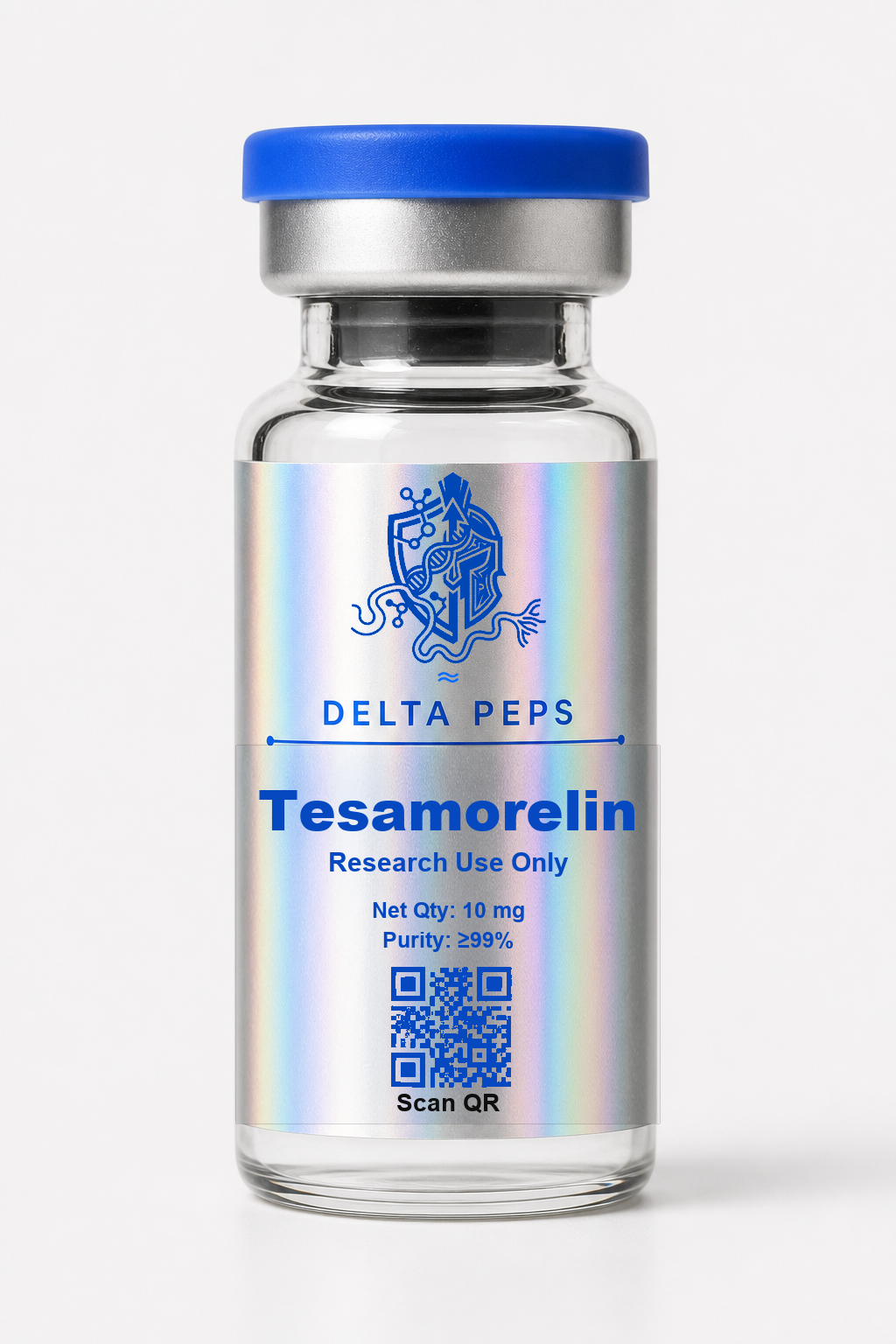
Tesamorelin — For Research Use Only
Research Use Only. All products currently listed on this site are for research purposes only. Products are not intended for human or animal consumption, dosing, injection, ingestion, or therapeutic use.
Inventory waitlist open — documentation available now
FOR RESEARCH USE ONLY. Not for human consumption, medical use, or therapeutic application of any kind.
Batch specifications
- Compound
- Tesamorelin
- Net quantity
- 10 mg
- Form
- Lyophilized powder
- HPLC purity
- ≥99%
- Current lot
DP-TES-001- Testing panel
- HPLC · Mass Spec · LAL Endotoxin
- Storage
- 2–8°C, protected from light
Lot Documentation & Testing
Each lot is tested by HPLC (purity), mass spectrometry (identity confirmation), and LAL endotoxin assay prior to release. COA documentation is pending finalization — lot number is reserved and testing is underway. QR-linked COA will be published to the vial and the COA library when the batch is released.
Join the inventory waitlist. This batch is not yet available to order. Review the COA and specifications above, then request notification when inventory opens.
Request inventory alert
FOR RESEARCH USE ONLY — Molecular Research Profile
Tesamorelin — Molecular Research Profile
Tesamorelin is a 44-residue synthetic analog of human growth hormone-releasing hormone (GHRH) in which the native GHRH(1-44)-NH₂ sequence is conjugated at the α-amino group of Tyr¹ with a trans-3-hexenoic acid (t-3-HA) moiety — a modification that stabilizes the amphipathic N-terminal α-helix required for high-affinity engagement of the GHRH receptor (GHRHR) in pituitary somatotroph cell-line assays, conferring measurable resistance to plasma exopeptidase activity compared with unmodified GHRH(1-44).
Molecular Architecture
- Backbone
- GHRH(1-44)-NH₂ — 44-amino-acid peptide derived from native human GHRH; C-terminal amidation preserves receptor-binding conformation
- N-terminal modification
- trans-3-hexenoic acid (t-3-HA; C6 unsaturated acyl moiety) conjugated via amide bond to α-amino group of Tyr¹; confers exopeptidase resistance in plasma stability assays
- Molecular weight
- 5,135.8 Da (free base); single peak by ESI-HRMS; formula C₂₂₅H₃₅₈N₇₂O₆₄S
- Secondary structure
- Amphipathic α-helix from approximately residues 1–29; critical for GHRHR engagement; residues 1–9 constitute the minimal pharmacophore for receptor activation in cell assays (Bowers et al. 1991)
- Modifications
- No disulfide bonds; no glycosylation sites; C-terminal –NH₂; single molecular species confirmed by HPLC
Receptor Binding and Signaling Mechanics
Tesamorelin engages the GHRH receptor (GHRHR; UniProt Q02643), a Class B1 (secretin-family) GPCR expressed on somatotroph cell lines. Competitive displacement of [¹²⁵I]-GHRH from GHRHR-expressing pituitary membrane preparations yields Ki values in the 0.1–1 nM range for the GHRH pharmacophore class (Laferrère & Hart, 1998; Jetté et al., 2005 J. Neuroendocrinol.). The t-3-HA modification extends half-life in peptidase assays without altering receptor binding affinity in published biochemical characterizations.
Intracellular signaling cascade:
- GHRHR activation → Gαs dissociation → adenylyl cyclase stimulation → cAMP ↑ (HTRF cAMP assay in GH3 or GHRHR-overexpressing HEK293, EC50 ~0.01–0.1 nM)
- cAMP → PKA → CREB Ser133 phosphorylation (secondary kinetics assay)
- IP₃ secondary pathway: Gαq-mediated PLC activation → [Ca²⁺]i mobilization in GH3 somatotroph cells (Fluo-4 AM assay)
- β-arrestin-2 recruitment measurable by PathHunter assay in U2OS-GHRHR cells
- GH gene transcription: CRE-luciferase reporter assay in transfected GH3 cells (functional downstream read)
In Vitro Research Profile
- Primary assay
- cAMP accumulation in GH3 (rat pituitary somatotroph) or GHRHR-overexpressing HEK293 cells; HTRF cAMP assay; 30-min stimulation at 37°C; EC50 class ~0.01–0.1 nM
- Calcium assay
- [Ca²⁺]i mobilization by Fluo-4 AM fluorescence (490/520 nm) in GH3 cells; 10-min kinetic read on plate reader; characterizes Gαq secondary pathway contribution
- Receptor binding
- Competitive radioligand displacement with [¹²⁵I]-GHRH at GHRHR-expressing membrane preparations; SPA or filtration format; Ki determination by Cheng-Prusoff correction
- Concentration range
- 0.001–100 nM for dose-response; 3-fold serial dilution recommended; vehicle DMSO ≤0.01% v/v
- Stability
- Assess by RP-HPLC at 0, 4, 24, 48 h in 50% human serum at 37°C; t-3-HA modification resists N-terminal exopeptidase cleavage vs. native GHRH(1-44) in parallel stability assays
- Analog comparison
- Native GHRH(1-44)-NH₂ (no t-3-HA); GHRH(1-29)-NH₂ (minimal pharmacophore); Sermorelin (GHRH(1-29)-NH₂) as reference standard
Research Use Only — Regulatory Notice
All compounds on this page are sold exclusively for in vitro laboratory research. They are not approved by the FDA, DEA, or any regulatory agency for human or animal use, therapeutic application, clinical investigation, or consumption of any kind. Binding affinities, IC50/EC50 values, and signaling cascade descriptions referenced herein derive from published in vitro and cell-based literature and do not constitute efficacy or safety claims. Researchers are responsible for complying with all applicable institutional, local, and federal regulations governing the handling and use of research chemicals.