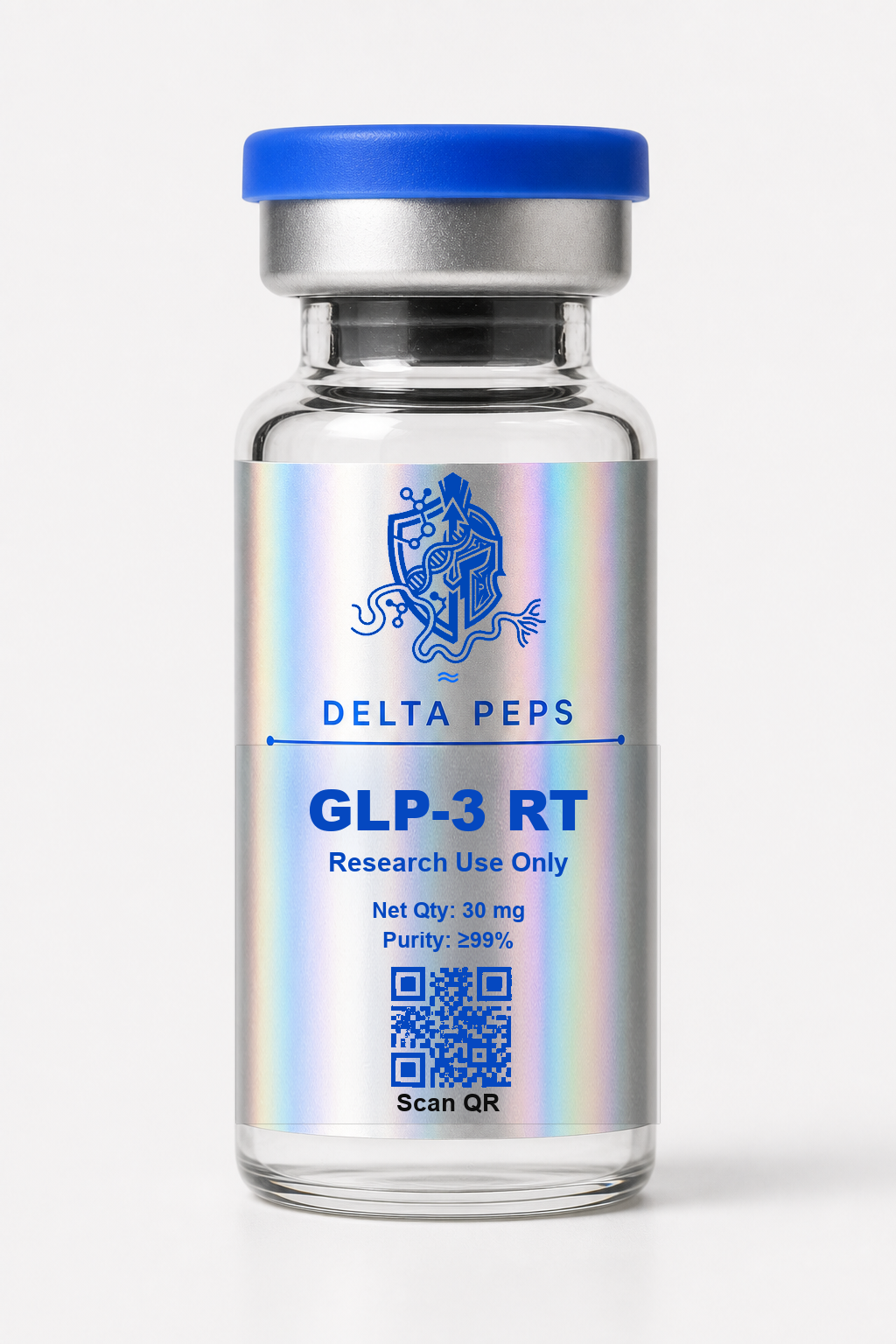
GLP-3 RT Peptide Analog — For Research Use Only
Research Use Only. All products currently listed on this site are for research purposes only. Products are not intended for human or animal consumption, dosing, injection, ingestion, or therapeutic use.
Inventory waitlist open — documentation available now
FOR RESEARCH USE ONLY. Not for human consumption, medical use, or therapeutic application of any kind.
Batch specifications
- Compound
- GLP-3 RT Peptide Analog
- Net quantity
- 30 mg
- Form
- Lyophilized powder
- HPLC purity
- ≥99%
- Current lot
DP-GLP3-001- Testing panel
- HPLC · Mass Spec · LAL Endotoxin
- Storage
- 2–8°C, protected from light
Lot Documentation & Testing
Each lot is tested by HPLC (purity), mass spectrometry (identity confirmation), and LAL endotoxin assay prior to release. COA documentation is pending finalization — lot number is reserved and testing is underway. QR-linked COA will be published to the vial and the COA library when the batch is released.
Join the inventory waitlist. This batch is not yet available to order. Review the COA and specifications above, then request notification when inventory opens.
Request inventory alert
FOR RESEARCH USE ONLY — Molecular Research Profile
GLP-3 RT — Molecular Research Profile
GLP-3 RT is a synthetic proglucagon-derived peptide analog engineered to probe binding selectivity across the Class B1 GPCR subfamily in multi-receptor panel assays, featuring backbone modifications at specified positions intended to differentiate receptor-contact contributions relative to native GLP-1 and GLP-2 pharmacophore sequences. Its structural design makes it a candidate research tool for receptor selectivity characterization in cell-based binding and cAMP assay formats.
Molecular Architecture
- Backbone
- Proglucagon-derived analog with sequence modifications at multiple positions to modulate receptor selectivity; molecular weight in the 3,400–3,800 Da range by HPLC-MS characterization
- Molecular weight
- Confirmed single peak by ESI-MS at expected m/z; ≥99% HPLC purity (single molecular entity)
- Secondary structure
- Predicted N-terminal amphipathic α-helix (residues 1–~15) consistent with Class B GPCR engagement model; no disulfide bonds; no lipidation or glycosylation
- N-terminal
- Native pharmacophore retained; position 2 and C-terminal modifications differentiate from endogenous GLP-1/GLP-2 sequences
- Key note
- A formally designated "GLP-3 receptor" is not currently assigned in the IUPHAR database; this compound is designed for receptor panel selectivity assays against GLP-1R, GLP-2R, and GCGR in parallel
Receptor Binding and Signaling Mechanics
GLP-3 RT is characterized using multi-receptor panel assay formats across the glucagon receptor family (Class B1 GPCRs: GLP-1R, GLP-2R, and GCGR). Competitive radioligand displacement assays using [¹²⁵I]-glucagon or fluorescent-tracer peptides at membranes from cells overexpressing individual receptor subtypes allow selectivity profiling. If receptor engagement occurs, all three family members couple to Gαs, activating adenylyl cyclase and elevating intracellular cAMP, detectable by HTRF or AlphaScreen. Downstream CREB Ser133 phosphorylation can be assayed by Western blot as a secondary functional endpoint.
Intracellular signaling cascade:
- Receptor panel binding: competitive displacement at GLP-1R / GLP-2R / GCGR membranes in parallel SPA or TR-FRET format
- If engagement confirmed: Gαs → adenylyl cyclase → cAMP ↑ (HTRF cAMP assay in receptor-overexpressing CHO-K1 or HEK293)
- cAMP → PKA → CREB Ser133 phosphorylation (Western blot or HTRF secondary endpoint)
- β-arrestin recruitment assay (BRET or PathHunter) in cells transfected with individual receptor constructs for biased-agonism characterization
- Reference agonists required in every panel: GLP-1(7-36)NH₂ (GLP-1R), GLP-2(1-33) (GLP-2R), glucagon (GCGR)
In Vitro Research Profile
- Primary assay
- Multi-receptor binding panel: [¹²⁵I]-glucagon radioligand displacement or homogeneous TR-FRET with fluorescent tracer at membranes from CHO-K1 cells stably expressing GLP-1R, GLP-2R, or GCGR individually
- Functional assay
- cAMP accumulation at each individual receptor; HTRF cAMP kit; 30-min incubation; full concentration-response from 1 pM to 10 µM
- Cell lines
- CHO-K1 or HEK293 stable transfectants expressing individual receptors; confirm expression by radioligand binding saturation before use
- Concentration range
- 1 pM – 10 µM for selectivity profiling; include 8-point concentration series with 3-fold dilutions
- Known limitations
- Published indexed-literature characterization specific to GLP-3 RT is limited; researchers should treat initial results as hypothesis-generating and include full reference agonist panels for data normalization
Research Use Only — Regulatory Notice
All compounds on this page are sold exclusively for in vitro laboratory research. They are not approved by the FDA, DEA, or any regulatory agency for human or animal use, therapeutic application, clinical investigation, or consumption of any kind. Binding affinities, IC50/EC50 values, and signaling cascade descriptions referenced herein derive from published in vitro and cell-based literature and do not constitute efficacy or safety claims. Researchers are responsible for complying with all applicable institutional, local, and federal regulations governing the handling and use of research chemicals.
Description
FOR RESEARCH USE ONLY. Not for human consumption, medical use, or therapeutic application of any kind.
A synthetic peptide analog studied in vitro as a triple agonist of the glucagon (GCGR), GIP, and GLP-1 receptors. In receptor-transfected cell cultures it has been characterized for activation of adenylyl cyclase and resulting cAMP accumulation across all three receptors, with published structural and pharmacology studies examining its binding mode and relative potency in these in vitro systems.
Research Specifications
- Purity: 99%+ (HPLC — Freedom Diagnostics)
- Testing: HPLC · Mass Spectrometry · LAL Endotoxin
- Form: Lyophilized powder
- Storage: 2–8°C, protected from light
Why Researchers Choose This Catalog
- Third-party verified purity — every batch, not sampled
- Mass spectrometry confirmation of identity
- Endotoxin-screened (LAL method)
- QR code on every vial links to Freedom Diagnostics COA lookup
- Lot-numbered inventory with corresponding batch documentation