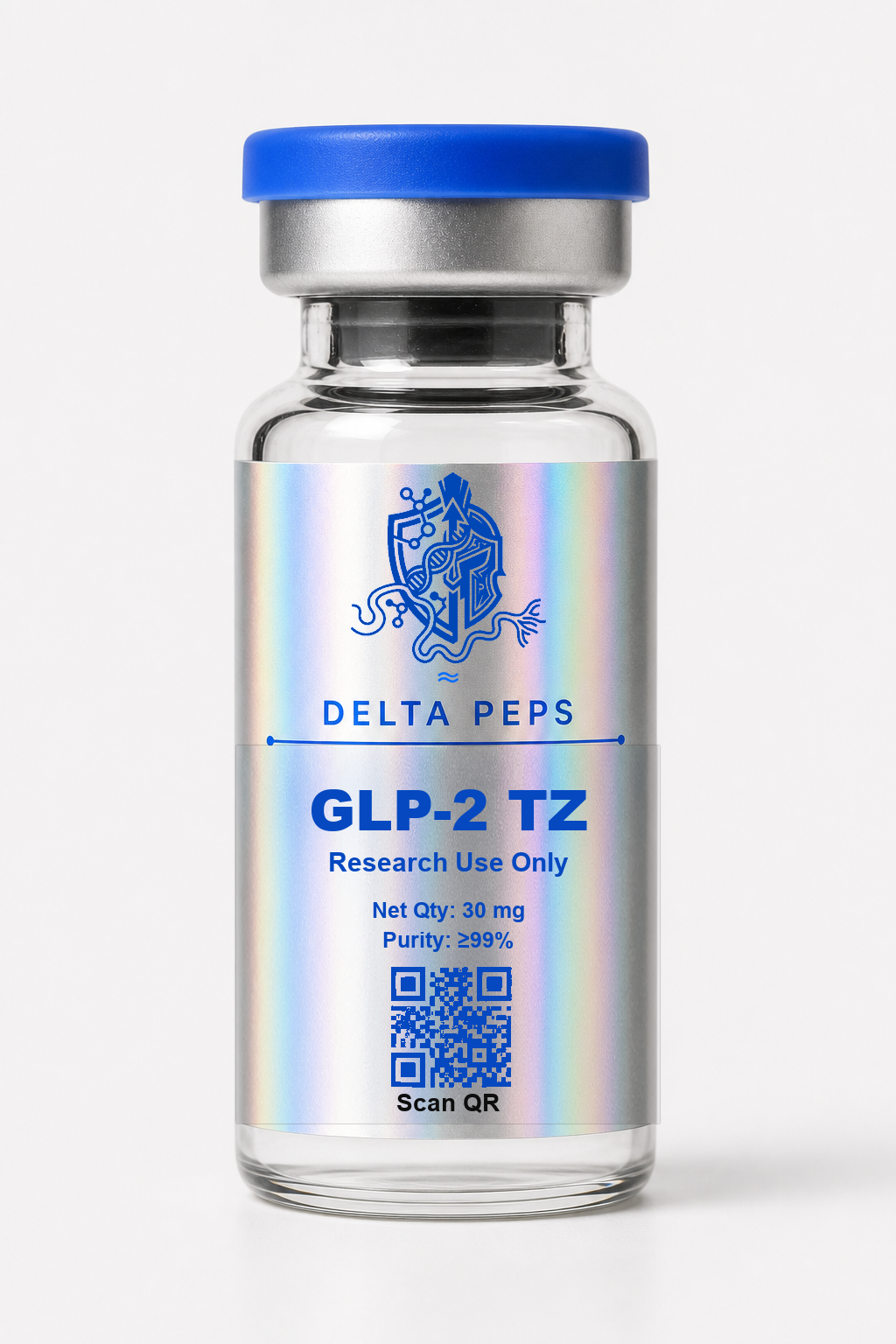
GLP-2 TZ Peptide Analog — For Research Use Only
Research Use Only. All products currently listed on this site are for research purposes only. Products are not intended for human or animal consumption, dosing, injection, ingestion, or therapeutic use.
Inventory waitlist open — documentation available now
FOR RESEARCH USE ONLY. Not for human consumption, medical use, or therapeutic application of any kind.
Batch specifications
- Compound
- GLP-2 TZ Peptide Analog
- Net quantity
- 30 mg
- Form
- Lyophilized powder
- HPLC purity
- ≥99%
- Current lot
DP-GLP2-001- Testing panel
- HPLC · Mass Spec · LAL Endotoxin
- Storage
- 2–8°C, protected from light
Lot Documentation & Testing
Each lot is tested by HPLC (purity), mass spectrometry (identity confirmation), and LAL endotoxin assay prior to release. COA documentation is pending finalization — lot number is reserved and testing is underway. QR-linked COA will be published to the vial and the COA library when the batch is released.
Join the inventory waitlist. This batch is not yet available to order. Review the COA and specifications above, then request notification when inventory opens.
Request inventory alert
FOR RESEARCH USE ONLY — Molecular Research Profile
GLP-2 TZ — Molecular Research Profile
GLP-2 TZ is a synthetic 33-residue peptide analog designed to engage the glucagon-like peptide-2 receptor (GLP-2R), incorporating a C18 fatty-acid acylation chain via a γGlu-mini-PEG linker at a specified lysine residue — a structural motif that reduces aqueous diffusion rates and extends apparent half-life in cell-culture media compared with unmodified GLP-2. Its modified N-terminal Ala²→Gly substitution confers measurable resistance to dipeptidyl peptidase-4 (DPP-IV) in cell-free enzymatic assays.
Molecular Architecture
- Backbone
- 33-amino-acid peptide; sequence derived from proglucagon-encoded GLP-2 with Ala²→Gly substitution for DPP-IV resistance in cell-free peptidase assays
- Lipidation
- C18 diacid (octadecanedioic acid) conjugated via γGlu-mini-PEG linker at Lys¹⁶; enables albumin-binding in serum assay matrices (class Kd ~1–10 µM for acyl-HSA interactions)
- Molecular weight
- ~3,800–4,200 Da (linker-configuration dependent); single molecular entity confirmed by HPLC-MS at ≥99%
- Secondary structure
- N-terminal amphipathic α-helix (residues 1–14) required for GLP-2R engagement; C-terminal tail provides secondary receptor-contact surface; no disulfide bonds
- Modifications
- C-terminal –NH₂ amide; N-terminal Gly¹ free amine conjugated to γGlu-PEG-C18 acyl chain
Receptor Binding and Signaling Mechanics
GLP-2 TZ targets GLP-2R (GLP2R gene; UniProt P49190), a Class B1 (secretin-family) GPCR. The binding mechanism follows the two-domain model characteristic of Class B1 receptors: the N-terminal peptide segment docks to the receptor extracellular domain (ECD) while the C-terminal helix engages the transmembrane bundle. Competitive displacement of radiolabeled GLP-2 from GLP-2R-overexpressing CHO cell membranes demonstrates IC50 values in the 0.1–1 nM range for the native GLP-2 pharmacophore class (Yusta et al., 2000; Munroe et al., 1999 J. Biol. Chem.).
Intracellular signaling cascade:
- GLP-2R activation → Gαs dissociation → adenylyl cyclase (AC) stimulation
- AC → intracellular cAMP accumulation (HTRF cAMP assay in CHO-GLP-2R, EC50 class ~0.1–1 nM)
- cAMP → PKA holoenzyme dissociation → CREB Ser133 phosphorylation
- β-arrestin-2 recruitment measurable by BRET or PathHunter split-enzyme assay
- GLP-2R does not couple to Gαi or Gαq at physiological agonist concentrations in standard cell assays
In Vitro Research Profile
- Primary assay
- cAMP accumulation in GLP-2R-overexpressing CHO-K1 or HEK293 cells; HTRF or AlphaScreen cAMP kit; 30-min stimulation at 37°C
- Secondary assay
- β-arrestin-2 recruitment via BRET (RLuc8/Venus pair) or Tango assay in U2OS-GLP-2R-tTA cells; characterizes biased agonism vs. native GLP-2
- Concentration range
- 0.001–100 nM for full dose-response; vehicle DMSO ≤0.1% v/v in assay wells; include GLP-2(1-33) reference agonist in all runs
- Stability (PBS)
- Assess by RP-HPLC (C18 column) at 0, 4, 24, 72 h at 37°C in PBS pH 7.4; C18 acylation extends apparent half-life in 50% human serum relative to unmodified GLP-2 in peptidase assay
- Analog comparison
- Native GLP-2(1-33) lacks C18 acylation; Ala²→Gly substitution alone shifts DPP-IV cleavage half-life from minutes to hours in enzyme assay; acylated analog adds albumin-mediated diffusion retardation
- Known limitations
- Published EC50 data specific to GLP-2 TZ formulation not yet in indexed literature; researchers should run full concentration-response in their certified receptor cell line
Research Use Only — Regulatory Notice
All compounds on this page are sold exclusively for in vitro laboratory research. They are not approved by the FDA, DEA, or any regulatory agency for human or animal use, therapeutic application, clinical investigation, or consumption of any kind. Binding affinities, IC50/EC50 values, and signaling cascade descriptions referenced herein derive from published in vitro and cell-based literature and do not constitute efficacy or safety claims. Researchers are responsible for complying with all applicable institutional, local, and federal regulations governing the handling and use of research chemicals.
Description
FOR RESEARCH USE ONLY. Not for human consumption, medical use, or therapeutic application of any kind.
A synthetic peptide analog studied in vitro as a dual agonist of the GIP and GLP-1 receptors. In cell-based assays using lines recombinantly expressing the GIP receptor or GLP-1 receptor, it has been characterized for stimulation of cAMP accumulation at each receptor, with published work examining its relative potency and receptor-binding affinity across these in vitro systems.
Research Specifications
- Purity: 99%+ (HPLC — Freedom Diagnostics)
- Testing: HPLC · Mass Spectrometry · LAL Endotoxin
- Form: Lyophilized powder
- Storage: 2–8°C, protected from light
Why Researchers Choose This Catalog
- Third-party verified purity — every batch, not sampled
- Mass spectrometry confirmation of identity
- Endotoxin-screened (LAL method)
- QR code on every vial links to Freedom Diagnostics COA lookup
- Lot-numbered inventory with corresponding batch documentation